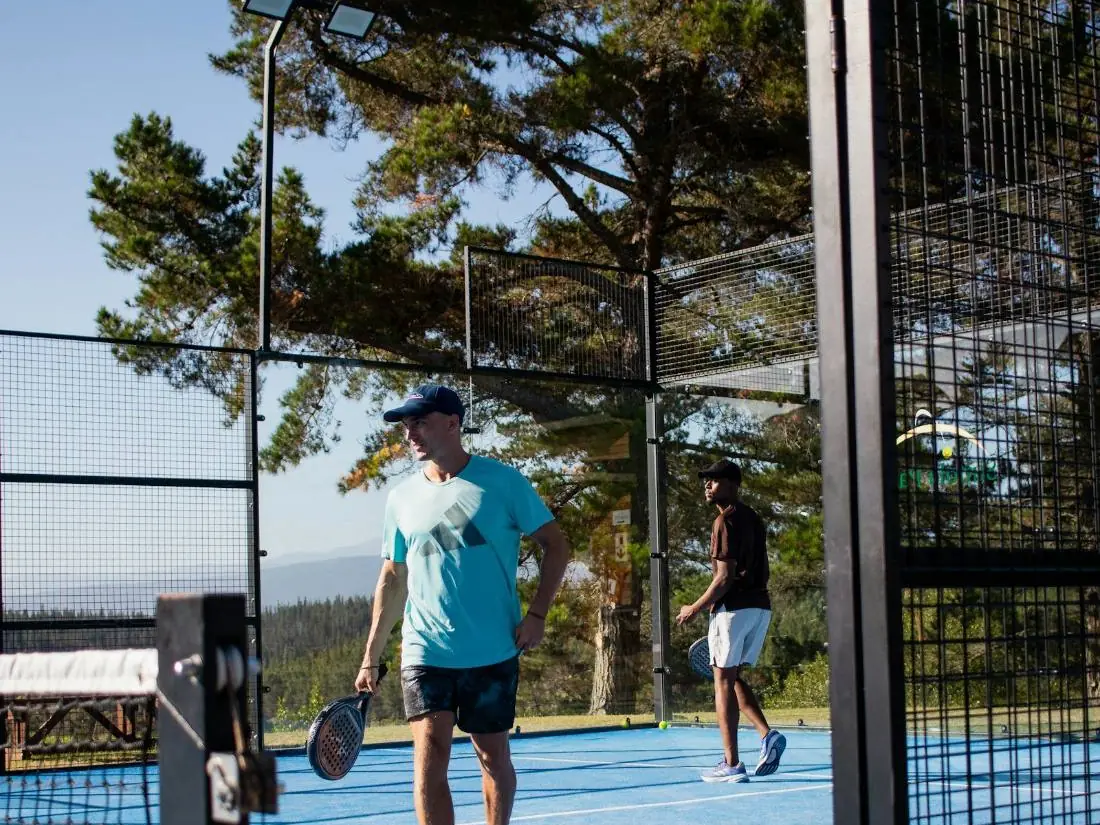
What a backyard padel court involves
Short answer: a backyard padel court needs a flat, well-drained area of roughly 40 by 80 feet, a reinforced concrete slab, a prefabricated court system (steel frame, tempered glass back walls and mesh sides), artificial turf with sand infill, and usually LED lighting. A residential builder coordinates the slab and installs the court system.
Unlike a pickleball or basketball court, a padel court is a structure, not just a surface. The glass walls are part of the game, so the frame is bolted to a slab designed to carry it. That's why the slab, drainage and access for delivery matter as much as the court you pick.
Most homeowners choose a standard court (steel posts with glass panels) because it costs less than a panoramic court. Some choose a single court (6 m wide instead of 10 m) for tight lots; it plays one-on-one and costs less, but you lose doubles, which is how most people play padel.
Checking your yard before you call
- Space. The court is 10 × 20 m. With a slab margin and room to walk around and for light poles, plan on about 12 × 24 m. Measure it, and mark it out with stakes and string to see how it sits.
- Slope. A flat lawn keeps site work cheap. A slope means grading, retaining or a raised slab, which can add a lot.
- Access. Glass panels and steel arrive on a truck. Ask how close it needs to get and how panels are moved to the pad if the court is behind the house.
- Drainage. Water has to run off the slab and away from the house. Builders often add a slight fall and a drain line.
- Power. Lighting needs a circuit, often a dedicated one. Note where your panel is.
- Neighbors and HOA. Lights and the sound of play carry. Check with your HOA and city about setbacks, height, lighting and noise before you sign.
Choices that change the price
| Choice | Lower cost | Higher cost |
|---|---|---|
| Court type | Standard (posts, 10 mm glass) | Panoramic (no side posts, thicker glass) |
| Court size | Single court (6 × 20 m) | Full doubles court (10 × 20 m) |
| Base | Reuse a sound, flat slab | New engineered slab, grading, drainage |
| Lighting | None or 4 fixtures | 8-fixture LED with dimming and timers |
| Extras | Basic gate and net | Custom colors, logo turf, seating, shade, fencing |
The court system itself is usually the largest single line. Freight is real money too, especially for courts shipped from Europe. See the padel court cost guide for ranges and an estimator.
How a residential build usually goes
- Site visit or photos. The builder checks space, slope, access and power.
- Proposal. Court system, slab spec, lighting, freight, schedule and payment terms.
- Order. The court system is ordered; lead times vary by maker and season.
- Site work and slab. Excavation, base, forms, reinforcement and pour, then curing time before installation.
- Installation. Frame, glass, mesh, turf with sand infill, net, lights.
- Walkthrough. Care instructions, turf brushing, sand top-ups and warranty paperwork.
What to ask a backyard court builder
- Who makes the court system, and where does it ship from?
- Is the slab included, and who designs it?
- What's included: freight, unloading, turf, sand, lighting, gate, net?
- How many residential courts have you installed, and can I see one?
- What warranty covers the structure, glass, turf and lights, and who honors it?
- What has your local permitting looked like on similar projects? (Then confirm with your city.)
Questions
How big is a backyard padel court?
The playing area is 10 × 20 m (about 33 × 66 ft). With a slab margin and space to move around it, most backyards need about 12 × 24 m (40 × 80 ft).
Can I build a padel court on my existing patio or slab?
Sometimes. The slab must be big enough, flat and strong enough to anchor the frame. A builder needs to inspect it; many old slabs need repair or replacement.
Is a single (singles) court worth it?
If space is tight, yes. A single court is 6 m wide and costs less, but most padel is played as doubles.
Do I need a permit?
It depends on your city, county and HOA, and on what's included (slab, lighting, structure). Ask your local building department and HOA, and ask builders what they needed on recent projects near you.